Yesterday we arrived back home after our visit to Namibia was abruptly interrupted. I had to go to Gauteng for urgent business and Regina had to get to the Eastern Cape to see her mother and sister in Patensie.
Regina left Windhoek the previous Thursday morning and traveled the 2,000 km to Patensie in two days. I managed to get a flight to Gauteng on that Saturday night and spent the week Centurion.
I got a flight to Port Elizabeth on Friday night and spend Saturday with Regina at her family's farm in Patensie. On Sunday afternoon we arrived back home.
At the moment we are not sure exactly what is going to happen in the next week, but we might be going back to Namibia in the near future.
It is really good to be back home. Today I drove on the new bridge between the N1 and M5. Yes, we missed all the World Cup excitement. We heard a couple of Vuvuzelas in Windhoek and saw some of the last matches on TV.
I still plan to post some of our other interesting photos but will need some time to select and place that.
Till next time.
Monday, July 26, 2010


Monday, July 12, 2010
A mystery debunked
The last two weeks were very hectic with the installation part of the project starting. We all have lots to to and with us on the road most of the time, the places we visited did not have Internet access, so I can only update the blog now.
Back to the story.
During my high school career I travelled to, what was then called, South West Africa. We visited Windhoek, Swakopmund, Ai-Ais Hot Springs, Etosha Game Park and my dad’s relatives who lived on a farm between Outjo and Kamanjab. That, and the fact that we were pulling a caravan, meant that we stayed mostly on the main roads and never ventured into the deep interior parts of, what is now called, Namibia.
Somewhere in this same part of my life I read books about the country and always wanted to visit two specific areas. One of these is the Brandberg and the other is Spitskoppe.
Brandberg had special significance because I read that a rock painting was discovered depicting a white women and the author left the impression of this lonely white women that must have lived with the local tribe and was therefore drawn by a local artist around 2000 years ago. Spitskoppe is a rock formation that rises out of the level ground to enormous height and is apparently something to behold.
I still have not been close to Spitskoppe and would very much like the opportunity to go there if the official part of my job affords me the opportunity.
During the previous week Regina and I were however given the job to go and visit the Brandberg White Lady Lodge, the only lodge in the Brandberg conservancy area. I was really exited because at last I was able to visit that part of Namibia.
We had a very warm and friendly reception at the lodge and ended up spending two nihts at the lodge. Aubrey de Jager, the owner, as well as all his staff, really make an effort to let everybody feel at home and have a good time. The result is a relaxed atmosphere where adults and children relax.
Aubrey told us that he believes the name of the Brandberg (direct translation: Fire Mountain) is derived from the fact that the mountain is coloured red by the rising sun. We got up early the next morning and managed to get a couple of stunning photos of the mountain at sunrise. I stitched together this one to give you an idea of what we saw. It was just much more spectacular than the picture manage to reflect.

We also took photos late in the afternoon to show what the mountain look like under different lighting.

After breakfast we went to see the White Lady of the Brandberg. We were warned not to go to late in the morning since it is a stiff walk of about 2.5 km from the parking spot to the site of the rock paintings. Even in winter it can get very warm in the ravine where one walk.
In earlier days people apparently poured water on the paintings to make it more visible, with the result that the main figure is now very faded. Since the site has been declared as a Namibian Heritage, visitors are only allowed to view the paintings when accompanied by a guide.
On the forty five minute walk to the site, the guide told us that the whole thing is actually a misnomer. The White Lady is neither white nor is it a lady. He gave us a long explanation about various people that visited the site from around 1917/18 to 1947 and published documents about the paintings. You can read the story on wikipedia.org but I have my own interpretation.
I believe that the drawing depicts a hunter who told the story of the day’s hunt and coloured his legs and lower body to represent an antelope, perhaps a springbok, which he shot during the hunt.
This picture shows the White Lady in the lower left corner with, what appears to be, a springbok just above it. Note the white legs and tummy of the springbok. In the top part of the photo is an antelope with legs like a human, also in white.

There are lots of controversies surrounding these drawings because it apparently dates from different times, about 3000 years apart and some are in brown monochrome while others are in three colors. Different people claim that it was painted by their ancestors but it looks very much like Bushmen/San paintings to me.
All I will remember about the outing is that the whole mystery turned out to be just somebody’s flight of fantasy. It also did get pretty uncomfortable on
Now I just need to get to Spitskoppe.....
Back to the story.
During my high school career I travelled to, what was then called, South West Africa. We visited Windhoek, Swakopmund, Ai-Ais Hot Springs, Etosha Game Park and my dad’s relatives who lived on a farm between Outjo and Kamanjab. That, and the fact that we were pulling a caravan, meant that we stayed mostly on the main roads and never ventured into the deep interior parts of, what is now called, Namibia.
Somewhere in this same part of my life I read books about the country and always wanted to visit two specific areas. One of these is the Brandberg and the other is Spitskoppe.
Brandberg had special significance because I read that a rock painting was discovered depicting a white women and the author left the impression of this lonely white women that must have lived with the local tribe and was therefore drawn by a local artist around 2000 years ago. Spitskoppe is a rock formation that rises out of the level ground to enormous height and is apparently something to behold.
I still have not been close to Spitskoppe and would very much like the opportunity to go there if the official part of my job affords me the opportunity.
During the previous week Regina and I were however given the job to go and visit the Brandberg White Lady Lodge, the only lodge in the Brandberg conservancy area. I was really exited because at last I was able to visit that part of Namibia.
We had a very warm and friendly reception at the lodge and ended up spending two nihts at the lodge. Aubrey de Jager, the owner, as well as all his staff, really make an effort to let everybody feel at home and have a good time. The result is a relaxed atmosphere where adults and children relax.
Aubrey told us that he believes the name of the Brandberg (direct translation: Fire Mountain) is derived from the fact that the mountain is coloured red by the rising sun. We got up early the next morning and managed to get a couple of stunning photos of the mountain at sunrise. I stitched together this one to give you an idea of what we saw. It was just much more spectacular than the picture manage to reflect.

We also took photos late in the afternoon to show what the mountain look like under different lighting.

After breakfast we went to see the White Lady of the Brandberg. We were warned not to go to late in the morning since it is a stiff walk of about 2.5 km from the parking spot to the site of the rock paintings. Even in winter it can get very warm in the ravine where one walk.
In earlier days people apparently poured water on the paintings to make it more visible, with the result that the main figure is now very faded. Since the site has been declared as a Namibian Heritage, visitors are only allowed to view the paintings when accompanied by a guide.
On the forty five minute walk to the site, the guide told us that the whole thing is actually a misnomer. The White Lady is neither white nor is it a lady. He gave us a long explanation about various people that visited the site from around 1917/18 to 1947 and published documents about the paintings. You can read the story on wikipedia.org but I have my own interpretation.
I believe that the drawing depicts a hunter who told the story of the day’s hunt and coloured his legs and lower body to represent an antelope, perhaps a springbok, which he shot during the hunt.
This picture shows the White Lady in the lower left corner with, what appears to be, a springbok just above it. Note the white legs and tummy of the springbok. In the top part of the photo is an antelope with legs like a human, also in white.

There are lots of controversies surrounding these drawings because it apparently dates from different times, about 3000 years apart and some are in brown monochrome while others are in three colors. Different people claim that it was painted by their ancestors but it looks very much like Bushmen/San paintings to me.
All I will remember about the outing is that the whole mystery turned out to be just somebody’s flight of fantasy. It also did get pretty uncomfortable on
Now I just need to get to Spitskoppe.....
Sunday, June 20, 2010
Scenery
As we traverse Namibia, one thing about this strangely beautiful country that keeps on amazing us is the variety of scenery that flash past our Fortuner's windows.
I grew up in Riviersonderned, a small town near Caledon in the Overberg. We used to call it the "Platteland" in Afrikaans. Directly translated it means "Flat Country" in English. I could never really understand this notion of it being flat because we were surrounded by hills and even had a very high mountain within 10 km from our home.
Here in Namibia the idea of the Platteland makes more sense to me; in some areas this place is FLAT. I must admit that here are more mountains than I expected but my lasting impression of the rural areas are that it is flat.
Sometimes when we come over a rise in the road we are absolutely speechless with the panorama that unfolds in front of us. The problem with trying to catch it on camera is that, with large parts of the country being fairly flat, is that the picture one is trying to take is also so big that it is virtually impossible to capture a scene in one photograph. Sometimes the scene that one would like to capture has already passed by the time we realise that it was worth taking.
The following are a couple of the scenes that we did manage to capture and would like to share with you.
On our way into Damaraland, close to a place called Bergsig, we saw what from afar looked like ground cover planted in a garden. It is actually fairly large rocks with shrubs in between.

The next photo is one of those where the camera is not capable of capturing the scene we saw. These mountains in Damaraland look so much more spectacular when you see in t in person, but here is a little glimpse of it. To see the real thing you will have to come look for yourselves.

We visited a farm called Rustig Toko, named after the Red Hornbill bird, and were taken to spot from where we saw this lush scene, looking towards the lodge. The farm is about 15 km south of the Etosha Pans and the recent rains also provided welcome relief in this area.

The mountains in the Sussosvlei area are also very spectacular but difficult to effectively capture on camera. The next couple of photos are all from this area.
The following picture reflect a little bit of the beauty that we saw. What I especially liked was the black band in the middle. We later saw that it shows up on top of the mountains to the right in the picture.

At Sossusvlei Desert Lodge Regina took this photo. Note the ancient dunes of the Namib on the right and the mountains on the left.

Sometimes we do manage to capture the essence of the scene as in the following photo. It gives a feeling of the stretched out country side and the never ending mountains that we saw.

On our way to Zebra River Lodge we drove through this unusual canyon. It was about 25 km off our the main roads but well worth the effort.

One of the trips took us down to Ai-Ais in the far south of Namibia. We went there just when the cold front hit Cape Town on Monday 14 June. As we approached Ai-Ais we could see the clouds building up and cast their shadows on the landscape.

Just as we got close to Ai-Ais it started to rain. I always enjoy driving in the rain but winter rain in Southern Namibia is very special. Fortunately we did not have to sleep in the rooftop tent that night because it came down in bucketfuls.

This last one made me chuckle. I work for a company that focus mainly on wireless communication systems suck as WiMAX, Wifi and VSAT. The following photo shows why wireless communication is very popular in Namibia. The nests on top of each telephone pole are built by communal weavers (afr.: versamel voeëls)

Next time I will put up some interesting photos we took that does not involve landscapes.
I grew up in Riviersonderned, a small town near Caledon in the Overberg. We used to call it the "Platteland" in Afrikaans. Directly translated it means "Flat Country" in English. I could never really understand this notion of it being flat because we were surrounded by hills and even had a very high mountain within 10 km from our home.
Here in Namibia the idea of the Platteland makes more sense to me; in some areas this place is FLAT. I must admit that here are more mountains than I expected but my lasting impression of the rural areas are that it is flat.
Sometimes when we come over a rise in the road we are absolutely speechless with the panorama that unfolds in front of us. The problem with trying to catch it on camera is that, with large parts of the country being fairly flat, is that the picture one is trying to take is also so big that it is virtually impossible to capture a scene in one photograph. Sometimes the scene that one would like to capture has already passed by the time we realise that it was worth taking.
The following are a couple of the scenes that we did manage to capture and would like to share with you.
On our way into Damaraland, close to a place called Bergsig, we saw what from afar looked like ground cover planted in a garden. It is actually fairly large rocks with shrubs in between.

The next photo is one of those where the camera is not capable of capturing the scene we saw. These mountains in Damaraland look so much more spectacular when you see in t in person, but here is a little glimpse of it. To see the real thing you will have to come look for yourselves.

We visited a farm called Rustig Toko, named after the Red Hornbill bird, and were taken to spot from where we saw this lush scene, looking towards the lodge. The farm is about 15 km south of the Etosha Pans and the recent rains also provided welcome relief in this area.

The mountains in the Sussosvlei area are also very spectacular but difficult to effectively capture on camera. The next couple of photos are all from this area.
The following picture reflect a little bit of the beauty that we saw. What I especially liked was the black band in the middle. We later saw that it shows up on top of the mountains to the right in the picture.

At Sossusvlei Desert Lodge Regina took this photo. Note the ancient dunes of the Namib on the right and the mountains on the left.
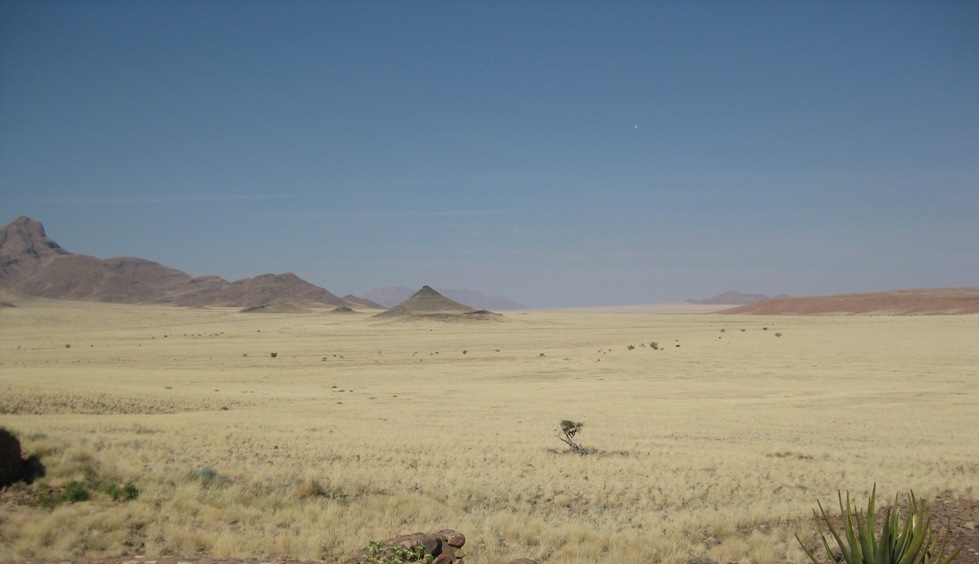
Sometimes we do manage to capture the essence of the scene as in the following photo. It gives a feeling of the stretched out country side and the never ending mountains that we saw.

On our way to Zebra River Lodge we drove through this unusual canyon. It was about 25 km off our the main roads but well worth the effort.

One of the trips took us down to Ai-Ais in the far south of Namibia. We went there just when the cold front hit Cape Town on Monday 14 June. As we approached Ai-Ais we could see the clouds building up and cast their shadows on the landscape.

Just as we got close to Ai-Ais it started to rain. I always enjoy driving in the rain but winter rain in Southern Namibia is very special. Fortunately we did not have to sleep in the rooftop tent that night because it came down in bucketfuls.

This last one made me chuckle. I work for a company that focus mainly on wireless communication systems suck as WiMAX, Wifi and VSAT. The following photo shows why wireless communication is very popular in Namibia. The nests on top of each telephone pole are built by communal weavers (afr.: versamel voeëls)

Next time I will put up some interesting photos we took that does not involve landscapes.
Wednesday, June 16, 2010
Hot and Cold
This week saw us making a quick dash down to the far south of Namibia to visit a couple of the Canyon Lodges, part of the Gondwana Collections group as well as Ai-Ais.
On Sunday we left Windhoek and stopped over in Keetmanshoop. En route we heard that a cold front has swept over South Africa and was on it's way to us. Fortunately we managed to find reasonable accommodation in the At Home B&B. The cold front hit us that night with a fury. Temperatures plummeted and we needed extra layers of cloths when we got up for breakfast on Monday morning.
We had to wait for a local representative to accompany us on our journey and walked around Keetmanshoop to get breakfast and managed to find a beany to protect my head against the cold at night.
We left Keetmanshoop around 11:00 and headed towards the canyon. We had three stops before we got to Ai-Ais around 17:00. Because of the project we are busy with, we managed to get a room for much less than the regular rates.
The last time we visited Ai-Ais was in the mid 1990's. Marthinus and Cecilia were just in their teens and we were reasonably impressed with the facilities offered at the resort.
Apparently the whole place was upgraded last year and the improvement from last time is obvious. The furnishings from the bedrooms to the indoor pools are stunning and the restaurant is very tastefully furnished. We treated ourselves to Eland steaks and a glass of Tall Horse Shiraz each. Afterwards we managed to expel some of the cold with two lazy hours in the indoor pool. Regina managed a couple of laps in the short space available while I just soaked up the heat.
After breakfast and the official part of the visit were completed, we headed east and north on the dirt roads for our next stop at Aroab.
Now please allow me to digress again for a little while.
We have a couple of dear friends from the time we stayed in Hermanus. Zoon and Stella Snyman both grew up in the Upington area and still love the Kalahari. Zoon always used a specific expression to describe a very busy place: "Dis soos nagmaal op Aroab" (eng.: "It is like communion in Aroab") Ever since the first time I heard Zoon say that, I had visions of what Aroab would look like; usually something to do with a bunch of ox wagon camped on the town square next to an old white-washed church building.
Yesterday those visions could make way for reality when we eventually reached Aroab for the first time. While I was doing the official part of our visit Regina took some photos.
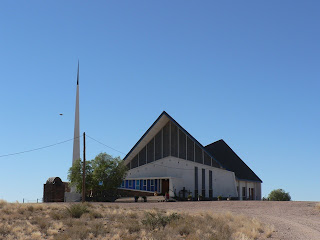
The church is everything but old and white-washed.
And I saw no ox wagons, just Toyota bakkies of all ages. This one was taken at one of the other sites we visited. It is of a 1973 Toyota Hilux bakkie in excellent condition and Simon, its proud owner.

We did not get "nagmaal" (direct translation: "evening meal") because it was not Sunday; we did not even get an afternoon meal because, like many towns in Namibia, the whole place shuts down between one and two for a lunch siesta.
At about 13:30, after filling the Fortuner up with Diesel, we left for Windhoek via the shortest route (read: dirt roads) and reached our temporary home in Windhoek just before 20:00 on Tuesday night. We covered a total of just more than 950 km of which only the last 260 km were on tarred roads.
 During the past 6 weeks since we left Cape Town we have driven a total of 9,500 km of which about 5,500 km were on dirt roads. The red lines on the map on the left gives an indication of the roads we have covered.
We are now back in Windhoek for a couple of days admin and some training for the implementation part of the project.
I will soon try to put together a page about some of the beautiful landscapes and rock formations we have seen on our travels.
On Sunday we left Windhoek and stopped over in Keetmanshoop. En route we heard that a cold front has swept over South Africa and was on it's way to us. Fortunately we managed to find reasonable accommodation in the At Home B&B. The cold front hit us that night with a fury. Temperatures plummeted and we needed extra layers of cloths when we got up for breakfast on Monday morning.
We had to wait for a local representative to accompany us on our journey and walked around Keetmanshoop to get breakfast and managed to find a beany to protect my head against the cold at night.
We left Keetmanshoop around 11:00 and headed towards the canyon. We had three stops before we got to Ai-Ais around 17:00. Because of the project we are busy with, we managed to get a room for much less than the regular rates.
The last time we visited Ai-Ais was in the mid 1990's. Marthinus and Cecilia were just in their teens and we were reasonably impressed with the facilities offered at the resort.
Apparently the whole place was upgraded last year and the improvement from last time is obvious. The furnishings from the bedrooms to the indoor pools are stunning and the restaurant is very tastefully furnished. We treated ourselves to Eland steaks and a glass of Tall Horse Shiraz each. Afterwards we managed to expel some of the cold with two lazy hours in the indoor pool. Regina managed a couple of laps in the short space available while I just soaked up the heat.
After breakfast and the official part of the visit were completed, we headed east and north on the dirt roads for our next stop at Aroab.
Now please allow me to digress again for a little while.
We have a couple of dear friends from the time we stayed in Hermanus. Zoon and Stella Snyman both grew up in the Upington area and still love the Kalahari. Zoon always used a specific expression to describe a very busy place: "Dis soos nagmaal op Aroab" (eng.: "It is like communion in Aroab") Ever since the first time I heard Zoon say that, I had visions of what Aroab would look like; usually something to do with a bunch of ox wagon camped on the town square next to an old white-washed church building.
Yesterday those visions could make way for reality when we eventually reached Aroab for the first time. While I was doing the official part of our visit Regina took some photos.

The church is everything but old and white-washed.
And I saw no ox wagons, just Toyota bakkies of all ages. This one was taken at one of the other sites we visited. It is of a 1973 Toyota Hilux bakkie in excellent condition and Simon, its proud owner.

We did not get "nagmaal" (direct translation: "evening meal") because it was not Sunday; we did not even get an afternoon meal because, like many towns in Namibia, the whole place shuts down between one and two for a lunch siesta.
At about 13:30, after filling the Fortuner up with Diesel, we left for Windhoek via the shortest route (read: dirt roads) and reached our temporary home in Windhoek just before 20:00 on Tuesday night. We covered a total of just more than 950 km of which only the last 260 km were on tarred roads.
 During the past 6 weeks since we left Cape Town we have driven a total of 9,500 km of which about 5,500 km were on dirt roads. The red lines on the map on the left gives an indication of the roads we have covered.
 We are now back in Windhoek for a couple of days admin and some training for the implementation part of the project.
I will soon try to put together a page about some of the beautiful landscapes and rock formations we have seen on our travels.
Friday, June 11, 2010
Where would this Road take us?
We covered some rather "untraveled" roads this week. Here is Regina's impressions of one such a trip:
Wednesday we drove from Rundu to Tsumeb. It sounds very simple and in effect only 430km. But that is only the short of it. The sweet? My dear Dirk enjoyed driving on/in the road. Like he says; for the first time since we drive the Fortuner we really, REALLY needed the 4x4 function. This redeem us from so often you will hear the accusation: most of your city dwellers do not need a 4x4 vehicle, it’s just show off.

Firstly, this is a new road that they are busy building to the north of the country. A statistic; 70% of Namibia’s population stays in the northern part of the country. If you look on the map you will notice the B1 and B8 are tarred and a short road 300km (compared to rest) from Ondangwa to Ruacana. Therefore they need to upgrade and increase the roads to meet the needs of the people in the northern regions.
I was only hanging onto my seat for dear life. The real experience of driving the road was Dirk’s privilege. I will leave the description of the experience to him.
While I was hanging on to my seat, I had a lot of time to look around and perceive the environment. When we left the Cape, my friends encouraged me to journal as we are travelling – we realized I will have a lot of time to kill. Sitting in the passenger’s seat leaves you with a lot of “nothingness” to do. So what does this looking around entail?
The saying that jumps to my mind is, “window of opportunity”. Looking out of the vehicle’s windows is not much experience but an opportune time to take pictures and show the environment as it shoots past you. We have seen mountains with the most extraordinary rock formations, sand dunes of different structures and color, vegetation that varies from sparse ground coverings, to lush forest type of growth.
When we came close to Grootfontein on Tuesday, we drove over a hill and suddenly this vast, stretched out landscape of just trees enfold in front of us. From the West to the East the skyline is just one line drawn by trees of various heights and shapes but not a mountain of any sorts. For us Capetonians that was a sure first.
Dirk's version:
When you have to choose between a 550 km round trip on tar roads and a 110 km bash through unknown terrain on an unmapped road.... Not much of a choice, we go the unmapped road!!
On one map it was indicated as "Road under construction" but boy, was that an understatement, as we saw this road in all stages of being constructed, from just two fences indicating the outline of the road, through various stages of preparation all the way to eventually a tar surface. The best part of this for me was the fact that the access road, on which we drove, turned out to be a very challenging track through the sand. The road starts 25 km south of the Angolan border and runs perpendicular to a series of small dunes. That gives you a fairly solid hill followed by various grades of soft sand. Many places it was possible to travel in forth gear at about 80 km/h. Some places I had to shift back to lower gears, even first, but the Fortuner kept going.
Unfortunately all good things eventually come to an end. That night we camped in Kupfer Quelle Resort, a campsite in Tsumeb, on the road to the south. It must count as one of the best, if not the best, campsite I ever stayed in. Everything is of a very high quality and very well maintained.
On Thursday we headed east via Grootfontein and visited places like Tsumkwe, Gam and Eiseb. We finished in Eiseb,7 km from the Botswana border at 16:45. There was no camping facilities so we decided to head south west towards Harnas Lion Farm, about 100 km north of Gobabis. It was still about 200 km and we headed down a road that was not indicated on any of the maps or even on Google Earth. It turned out to be the best dirt road we traveled on this whole six weeks in Namibia. While it was still light enough I managed to drive over 120 km/h without ever feeling worried.

We reached Harnas at just after 19:00 and managed to get campsites for the night as well as dinner and breakfast. At night we were treated to a host of wildlife noises,such as a pride of lions roaring close to the campsite, albeit behind electrified fences, warthogs, baboons and various night birds.
It got so cold at night that Regina got a very bad cold which she is now nursing from our ample medicine chest.
Today we only had one official visit to do and in the process met a very friendly and generous Oom Johannes Jacobs, alias Boerbok, even though very few people will call him that to his face. Once again we had to travel a couple hundred kilometers to see one site but managed to reach the place where we stay in Windhoek at 16:40.
Next week we plan a short trip to Ai-Ais and vicinity but more about that later.
Wednesday we drove from Rundu to Tsumeb. It sounds very simple and in effect only 430km. But that is only the short of it. The sweet? My dear Dirk enjoyed driving on/in the road. Like he says; for the first time since we drive the Fortuner we really, REALLY needed the 4x4 function. This redeem us from so often you will hear the accusation: most of your city dwellers do not need a 4x4 vehicle, it’s just show off.

Firstly, this is a new road that they are busy building to the north of the country. A statistic; 70% of Namibia’s population stays in the northern part of the country. If you look on the map you will notice the B1 and B8 are tarred and a short road 300km (compared to rest) from Ondangwa to Ruacana. Therefore they need to upgrade and increase the roads to meet the needs of the people in the northern regions.
I was only hanging onto my seat for dear life. The real experience of driving the road was Dirk’s privilege. I will leave the description of the experience to him.
While I was hanging on to my seat, I had a lot of time to look around and perceive the environment. When we left the Cape, my friends encouraged me to journal as we are travelling – we realized I will have a lot of time to kill. Sitting in the passenger’s seat leaves you with a lot of “nothingness” to do. So what does this looking around entail?
The saying that jumps to my mind is, “window of opportunity”. Looking out of the vehicle’s windows is not much experience but an opportune time to take pictures and show the environment as it shoots past you. We have seen mountains with the most extraordinary rock formations, sand dunes of different structures and color, vegetation that varies from sparse ground coverings, to lush forest type of growth.
When we came close to Grootfontein on Tuesday, we drove over a hill and suddenly this vast, stretched out landscape of just trees enfold in front of us. From the West to the East the skyline is just one line drawn by trees of various heights and shapes but not a mountain of any sorts. For us Capetonians that was a sure first.
Dirk's version:
When you have to choose between a 550 km round trip on tar roads and a 110 km bash through unknown terrain on an unmapped road.... Not much of a choice, we go the unmapped road!!
On one map it was indicated as "Road under construction" but boy, was that an understatement, as we saw this road in all stages of being constructed, from just two fences indicating the outline of the road, through various stages of preparation all the way to eventually a tar surface. The best part of this for me was the fact that the access road, on which we drove, turned out to be a very challenging track through the sand. The road starts 25 km south of the Angolan border and runs perpendicular to a series of small dunes. That gives you a fairly solid hill followed by various grades of soft sand. Many places it was possible to travel in forth gear at about 80 km/h. Some places I had to shift back to lower gears, even first, but the Fortuner kept going.
Unfortunately all good things eventually come to an end. That night we camped in Kupfer Quelle Resort, a campsite in Tsumeb, on the road to the south. It must count as one of the best, if not the best, campsite I ever stayed in. Everything is of a very high quality and very well maintained.
On Thursday we headed east via Grootfontein and visited places like Tsumkwe, Gam and Eiseb. We finished in Eiseb,7 km from the Botswana border at 16:45. There was no camping facilities so we decided to head south west towards Harnas Lion Farm, about 100 km north of Gobabis. It was still about 200 km and we headed down a road that was not indicated on any of the maps or even on Google Earth. It turned out to be the best dirt road we traveled on this whole six weeks in Namibia. While it was still light enough I managed to drive over 120 km/h without ever feeling worried.

We reached Harnas at just after 19:00 and managed to get campsites for the night as well as dinner and breakfast. At night we were treated to a host of wildlife noises,such as a pride of lions roaring close to the campsite, albeit behind electrified fences, warthogs, baboons and various night birds.
It got so cold at night that Regina got a very bad cold which she is now nursing from our ample medicine chest.
Today we only had one official visit to do and in the process met a very friendly and generous Oom Johannes Jacobs, alias Boerbok, even though very few people will call him that to his face. Once again we had to travel a couple hundred kilometers to see one site but managed to reach the place where we stay in Windhoek at 16:40.
Next week we plan a short trip to Ai-Ais and vicinity but more about that later.
Tuesday, June 8, 2010
Flashback
Today my memory was given a jerk and I was taken back to November 1983.
We were living in Hermanus at the time and Regina was three months pregnant with Cecilia. One morning I got a call, the one that all guys who were still doing camps dreaded. The voice on the other side identified himself as a corporal from the regiment I was affiliated to. He then asked: "Why are you not there?" I replied: "Where is there?" "Rundu" was his terse reply.
It turned out that they used my old address in Pretoria to call me up for a three months camp in Rundu on, what was then, the South West African northern border. I was then promptly rerouted to the next camp which started that same week in Messina, close to the Rhodesian border in Northern Transvaal. I missed the best 3 months of Regina's pregnancy with Cecilia as well as all our family birthdays, Christmas and our anniversary.
Well enough of the past. Tonight we sleep in Rundu! That is why I went down memory lane. We arrived here at 18:30 when it was already dark so we did not see much. When we went to the restaurant at the Kavango Sands Lodge, where we stay, we heard a hippo grunt down at the river. Tomorrow morning we will have breakfast again overlooking the Okavango river.
We left Windhoek at 12:00 today and traveled through an unusual landscape. After Grootfontein the horizon kept falling away below the tree line. It created the illusion of a never ending see of trees. Because it is so flat the road is straight and level all the way to the horizon.
Tomorrow we start with another round of work in this area and should be back in Windhoek on Friday.
We were living in Hermanus at the time and Regina was three months pregnant with Cecilia. One morning I got a call, the one that all guys who were still doing camps dreaded. The voice on the other side identified himself as a corporal from the regiment I was affiliated to. He then asked: "Why are you not there?" I replied: "Where is there?" "Rundu" was his terse reply.
It turned out that they used my old address in Pretoria to call me up for a three months camp in Rundu on, what was then, the South West African northern border. I was then promptly rerouted to the next camp which started that same week in Messina, close to the Rhodesian border in Northern Transvaal. I missed the best 3 months of Regina's pregnancy with Cecilia as well as all our family birthdays, Christmas and our anniversary.
Well enough of the past. Tonight we sleep in Rundu! That is why I went down memory lane. We arrived here at 18:30 when it was already dark so we did not see much. When we went to the restaurant at the Kavango Sands Lodge, where we stay, we heard a hippo grunt down at the river. Tomorrow morning we will have breakfast again overlooking the Okavango river.
We left Windhoek at 12:00 today and traveled through an unusual landscape. After Grootfontein the horizon kept falling away below the tree line. It created the illusion of a never ending see of trees. Because it is so flat the road is straight and level all the way to the horizon.
Tomorrow we start with another round of work in this area and should be back in Windhoek on Friday.
Kruis en Dwars
Regina het hierdie een in Afrikaans gedoen
(Ons het Vrydag al in Windhoek aangekom maar was besig om admin op datum te kry. Ons vertrek later vandag weer op pad na Tsumeb en Rundu en wou darem net so iets oor laasweek sê)

Ons is weer terug in Windhoek. Ons was vanaf Maandag tot Vrydag op die pad. Dit was ‘n goeie 2 060km en het ons net mooi oor die breedte van die land geneem. Sossusvlei aan die Weste en Kalahari in die Ooste. Weereens is ‘n mens sterk onder indruk van toerisme en dat baie van die land se bedrywighede daarom draai. So onherbergsaam soos die landskap lyk, so kontrasterend luuks is die akkomodasie. Dis wel pragtig gekamofleer in boustyl sodat dit werklik pragtig met die omgewing saam smelt. Ja, dit beteken baie klip word vir mure gebruik en strooi vir dakke. Dit sit ook tussen rotse en duine versteek, sodat dit jou aan wegkruipertjie laat dink. Omdat klip en strooi gebruik word wat ‘n baie aardse karakter aan die buite kante van die geboue gee, is die binne kante ‘n verrassing. Keurige en stylvolle materiale en meubels word gebruik om die interior mee te versier. Die vermoeide toeris moet die ervaring van ‘n oase beleef.
Die volgende ontbyt was werklik ‘n besonderse ervaring. Nou moet ek ook sê, ironies genoeg het ons ‘n smaakliker ontbyt by ‘n minder luukse hotel gehad, nl by Stoneys Country Lodge op Gochas. (in die aand dink jy die naam moet goggas wees, want sowat van ‘n vlieende insek en motte geroesemoes het ons lanklaas beleef((Dirk voel die noem van muskiete moet ook ingevoeg word))
Ons het by Sossusvlei Lodge ontbyt gehad. Wel-wel, die gebou se styl het ons baie aan Morokko se boustyle laat dink. Dis in die rooisand van die Namib woestyn genestel. (Die woord nestel pas pragtig hier, want dit lyk of die sand die plek omvou. Omdat hulle dieselfde rooi kleur van die woestyn sand vir hulle mure gebruik, is dit ‘n in-een-vloei van gebou en woestyn)

Ja, die gebou se beskrywing en atmosfeer kan my nog ‘n hele rukkie besig hou. Natuurlik is daar ‘n swembad en as jy daarin sit is dit so gelee dat die uitsig daarvan jou in een laat vloei met die droe rivierbedding en woestynsandwalle, maar as jy verder om jou kyk is dit groen gras en heerlike koelte sambrele met palms. Verder is daar ook fontein met lopende water geskep om die koelte van die water in die gebou in te bring. Die eet-area is hoofsaaklik vir buite ingerig. Ook die stoep se randmuurtjie is van so aard dat jy die kleinvolk(akkedisse, grond-eekorings, allerhande voels, ens) van die woestyn kan dophou terwyl jy eet.) Maar nou moet jy die kos sien om dit te waardeer, moet ‘n mens besef, 99% van die produkte moet aangery word en dit klink my die meeste kom van SA af. Daar is jou gewone spek, eiers, wors en ontbytgrane, maar beslis meer van ‘n keuse as die normale. Vars vrugteslaai en om die keuse groter te maak, ook ‘n verskeidenheid van ingelegde soorte vrugte. Yoghurt, omtrent 4 geure om van te kies. Dan het jy die koue vleise en ook salm en nog ‘n vis wat ek nie ondersoek het nie. Die kase is die soorte waarvan die Europeers hou, soos bv. Emantaller, ens. Die brode is dan ook tenminste 5 verskillende soorte om van te kies. Die bruin en wit is nie hierdie vierkantige skoenboks soorte nie, nee, heerlike ovale, rondes en wat nog. Tot rog en hierdie donkermele soos die Duitsers van hou. Natuurlik vrugtesappe en weereens kan die Europeers nie kla nie, want die koffie is voortreflik. Natuurlik is die rooibostee ook orals en veral in hierdie deftige plekke, is dit ook nog in ‘n verskydenheid van keuses. Nou ja, toe ons daar klaar was, nodeloos om te sê, ons was amper pe geeet, maar darem goeie krag ingekry om die dag verder aan te durf.
Dit was ‘n rowwe dag, want ons het 7 punte besoek en opgeskryf. Die ritte tussen elkeen was nooit minder as ‘n 20+ kilos nie en sommige tot 80 km(die afstand is nie so indrukwekkend nie, maar dis paaie wat jy dikwels nie vinniger as 60km per uur op kan ry nie.) En die sand/stof is later net mooi oral in en oor jou. Genoeg dankbaarheid vir ‘n “aircon” kan ek nie hê nie. Groot was ons dankbaarheid toe ons by die laaste besoekpunt van die dag kom. Ons het gereken om te kamp, m.a.w. in die daktent slaap, maar toe bied hulle vir ons ‘n kamer aan teen kamptariewe. Mensig is dit ‘n verligting as jy nie eers kamp hoef op te slaan voordat jy die nag tot ruste kom nie.
Ons Fortuner gedra hom baie goed en ons het alles en nog ‘n klomp onnodige goed. Ons het alreeds twee van hierdie ammobokse in Windhoek gelos en na hierdie rit gaan ek nog twee verminder en ook hier in Windhoek los. Op die oomblik beteken baie van die goed net ‘n onnodige spasie vullers en dat jy so baie goed moet verskuif as jy kamp opslaan. Omdat ‘n mens die meeste van die tyd in sand en grond staan, probeer jy om die goed in die Fortuner te hou, maar dit laat my dink aan hierdie speletjies soos tetris, jy skuif die een ding om in ‘n ander se spasie te pas en netnou moet dit weer in ‘n ander spasie om iets anders oop te kry. So op die ou end voel ek soos ‘n veldmuis, voortdurend besig, maar daar gaan werklik min aan.
Dirk is in sy element - mensig, ek het net nog nie so iets aanskou nie. Ek wonder of ek al veel meer as ‘n 500km van die 5 000+ km gery het (by gesê, dit was hoofsaaklik net teerpaaie), want Dirk sou nie graag van sy grondpaaie wil afstaan nie. Gister het ons ‘n roete gery wat net gery kan word as jy ‘n 4x4 voertuig het. Dit was ‘n kortpad en glo my, die waarheid oor die hoeveelheid minder kilos of ure is nie debateerbaar nie. Dit is ‘n regte duine pad, die ene sand en net ‘n twee-spoor. Die aankomende verkeer het hulle eie spoor wat ‘n goeie paar meters weg is en net so hier en daar met mekaar kruis.
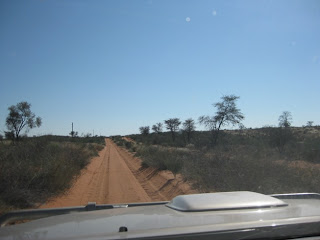
Nadat ek vir Dirk die stuk tot sover gelees het, was hy baie ontsteld oor my weergawe van hoeveel hy my toelaat om te bestuur. Regstellende aksie, ag ek meen, net regstelling (daardie stukkie is sommer net om te wys ek is nog ‘n Suid-Afrikaner in denke.) Iets wat ek nog nie gese het oor hierdie rondte nie, is dat Geoffrey, een van plaaslike manne, saam met ons moet ry. Omdat ons Fortuner so volgelaai is, moet hy in ‘n aparte voertuig ry. Hy ry hierdie paaie al baie jare en het etlike honderde duisende kilometers op Namibië se gronpaaie gery; hy kan sonder ‘n GPS die meeste plekke vind, en het dus baie gehelp deurdat hy voor gery het en so die paaie aangewys het. Nou hier kom Dirk se verweer; Geoffrey het selde minder as 100km per uur gery en dikwels 120, dit beteken jy moet jou ry ken – want dis GRONDPAAIE..... Nou ja, ek wou nie regtig meer bestuur het nie.
Ek het net weer soveel waardering vir vleis gekry. Eerstens pas dit my o-pos bloed so menu-pas as wat jy kan kry. Dit kan gedroog, gevries, gaar en klaar opgedis oral saam met jou gaan. Groente en vrugte kan nou maar net nie soveel “hammering” op ‘n lang-, rowwe-, stof-pad vat nie. En niemand gee om, om na ‘n uitputtende dag op die pad nog ‘n vuurtjie aanmekaar te slaan nie. So, het ons dan van die dae net op biltong, droewors, en braaivleis geleef; ons het darem moeite gedoen om drinkwater ook te he. ‘n Dieet van vleis en water, en dit doen ons nog net goed.
Vir my is dit ‘n paar dae van terugkeer tot normaal. Ek sal jok as ek se dis net lekker om so te ry. Verstaan my reg, die natuur is pragtig en wonderlik en om al die verskeidenheid te sien en te ervaar, maar dis vir baie kilos aan-een dieselfde. Ek voel soms verveeld en het nou al gevind dit werk ook nie om iets soos lees, skryf, rekenaarwerk, ens te doen nie. Wel, so is daar altyd iets om aan te werk.
(Ons het Vrydag al in Windhoek aangekom maar was besig om admin op datum te kry. Ons vertrek later vandag weer op pad na Tsumeb en Rundu en wou darem net so iets oor laasweek sê)

Ons is weer terug in Windhoek. Ons was vanaf Maandag tot Vrydag op die pad. Dit was ‘n goeie 2 060km en het ons net mooi oor die breedte van die land geneem. Sossusvlei aan die Weste en Kalahari in die Ooste. Weereens is ‘n mens sterk onder indruk van toerisme en dat baie van die land se bedrywighede daarom draai. So onherbergsaam soos die landskap lyk, so kontrasterend luuks is die akkomodasie. Dis wel pragtig gekamofleer in boustyl sodat dit werklik pragtig met die omgewing saam smelt. Ja, dit beteken baie klip word vir mure gebruik en strooi vir dakke. Dit sit ook tussen rotse en duine versteek, sodat dit jou aan wegkruipertjie laat dink. Omdat klip en strooi gebruik word wat ‘n baie aardse karakter aan die buite kante van die geboue gee, is die binne kante ‘n verrassing. Keurige en stylvolle materiale en meubels word gebruik om die interior mee te versier. Die vermoeide toeris moet die ervaring van ‘n oase beleef.
Die volgende ontbyt was werklik ‘n besonderse ervaring. Nou moet ek ook sê, ironies genoeg het ons ‘n smaakliker ontbyt by ‘n minder luukse hotel gehad, nl by Stoneys Country Lodge op Gochas. (in die aand dink jy die naam moet goggas wees, want sowat van ‘n vlieende insek en motte geroesemoes het ons lanklaas beleef((Dirk voel die noem van muskiete moet ook ingevoeg word))
Ons het by Sossusvlei Lodge ontbyt gehad. Wel-wel, die gebou se styl het ons baie aan Morokko se boustyle laat dink. Dis in die rooisand van die Namib woestyn genestel. (Die woord nestel pas pragtig hier, want dit lyk of die sand die plek omvou. Omdat hulle dieselfde rooi kleur van die woestyn sand vir hulle mure gebruik, is dit ‘n in-een-vloei van gebou en woestyn)

Ja, die gebou se beskrywing en atmosfeer kan my nog ‘n hele rukkie besig hou. Natuurlik is daar ‘n swembad en as jy daarin sit is dit so gelee dat die uitsig daarvan jou in een laat vloei met die droe rivierbedding en woestynsandwalle, maar as jy verder om jou kyk is dit groen gras en heerlike koelte sambrele met palms. Verder is daar ook fontein met lopende water geskep om die koelte van die water in die gebou in te bring. Die eet-area is hoofsaaklik vir buite ingerig. Ook die stoep se randmuurtjie is van so aard dat jy die kleinvolk(akkedisse, grond-eekorings, allerhande voels, ens) van die woestyn kan dophou terwyl jy eet.) Maar nou moet jy die kos sien om dit te waardeer, moet ‘n mens besef, 99% van die produkte moet aangery word en dit klink my die meeste kom van SA af. Daar is jou gewone spek, eiers, wors en ontbytgrane, maar beslis meer van ‘n keuse as die normale. Vars vrugteslaai en om die keuse groter te maak, ook ‘n verskeidenheid van ingelegde soorte vrugte. Yoghurt, omtrent 4 geure om van te kies. Dan het jy die koue vleise en ook salm en nog ‘n vis wat ek nie ondersoek het nie. Die kase is die soorte waarvan die Europeers hou, soos bv. Emantaller, ens. Die brode is dan ook tenminste 5 verskillende soorte om van te kies. Die bruin en wit is nie hierdie vierkantige skoenboks soorte nie, nee, heerlike ovale, rondes en wat nog. Tot rog en hierdie donkermele soos die Duitsers van hou. Natuurlik vrugtesappe en weereens kan die Europeers nie kla nie, want die koffie is voortreflik. Natuurlik is die rooibostee ook orals en veral in hierdie deftige plekke, is dit ook nog in ‘n verskydenheid van keuses. Nou ja, toe ons daar klaar was, nodeloos om te sê, ons was amper pe geeet, maar darem goeie krag ingekry om die dag verder aan te durf.
Dit was ‘n rowwe dag, want ons het 7 punte besoek en opgeskryf. Die ritte tussen elkeen was nooit minder as ‘n 20+ kilos nie en sommige tot 80 km(die afstand is nie so indrukwekkend nie, maar dis paaie wat jy dikwels nie vinniger as 60km per uur op kan ry nie.) En die sand/stof is later net mooi oral in en oor jou. Genoeg dankbaarheid vir ‘n “aircon” kan ek nie hê nie. Groot was ons dankbaarheid toe ons by die laaste besoekpunt van die dag kom. Ons het gereken om te kamp, m.a.w. in die daktent slaap, maar toe bied hulle vir ons ‘n kamer aan teen kamptariewe. Mensig is dit ‘n verligting as jy nie eers kamp hoef op te slaan voordat jy die nag tot ruste kom nie.
Ons Fortuner gedra hom baie goed en ons het alles en nog ‘n klomp onnodige goed. Ons het alreeds twee van hierdie ammobokse in Windhoek gelos en na hierdie rit gaan ek nog twee verminder en ook hier in Windhoek los. Op die oomblik beteken baie van die goed net ‘n onnodige spasie vullers en dat jy so baie goed moet verskuif as jy kamp opslaan. Omdat ‘n mens die meeste van die tyd in sand en grond staan, probeer jy om die goed in die Fortuner te hou, maar dit laat my dink aan hierdie speletjies soos tetris, jy skuif die een ding om in ‘n ander se spasie te pas en netnou moet dit weer in ‘n ander spasie om iets anders oop te kry. So op die ou end voel ek soos ‘n veldmuis, voortdurend besig, maar daar gaan werklik min aan.
Dirk is in sy element - mensig, ek het net nog nie so iets aanskou nie. Ek wonder of ek al veel meer as ‘n 500km van die 5 000+ km gery het (by gesê, dit was hoofsaaklik net teerpaaie), want Dirk sou nie graag van sy grondpaaie wil afstaan nie. Gister het ons ‘n roete gery wat net gery kan word as jy ‘n 4x4 voertuig het. Dit was ‘n kortpad en glo my, die waarheid oor die hoeveelheid minder kilos of ure is nie debateerbaar nie. Dit is ‘n regte duine pad, die ene sand en net ‘n twee-spoor. Die aankomende verkeer het hulle eie spoor wat ‘n goeie paar meters weg is en net so hier en daar met mekaar kruis.

Nadat ek vir Dirk die stuk tot sover gelees het, was hy baie ontsteld oor my weergawe van hoeveel hy my toelaat om te bestuur. Regstellende aksie, ag ek meen, net regstelling (daardie stukkie is sommer net om te wys ek is nog ‘n Suid-Afrikaner in denke.) Iets wat ek nog nie gese het oor hierdie rondte nie, is dat Geoffrey, een van plaaslike manne, saam met ons moet ry. Omdat ons Fortuner so volgelaai is, moet hy in ‘n aparte voertuig ry. Hy ry hierdie paaie al baie jare en het etlike honderde duisende kilometers op Namibië se gronpaaie gery; hy kan sonder ‘n GPS die meeste plekke vind, en het dus baie gehelp deurdat hy voor gery het en so die paaie aangewys het. Nou hier kom Dirk se verweer; Geoffrey het selde minder as 100km per uur gery en dikwels 120, dit beteken jy moet jou ry ken – want dis GRONDPAAIE..... Nou ja, ek wou nie regtig meer bestuur het nie.
Ek het net weer soveel waardering vir vleis gekry. Eerstens pas dit my o-pos bloed so menu-pas as wat jy kan kry. Dit kan gedroog, gevries, gaar en klaar opgedis oral saam met jou gaan. Groente en vrugte kan nou maar net nie soveel “hammering” op ‘n lang-, rowwe-, stof-pad vat nie. En niemand gee om, om na ‘n uitputtende dag op die pad nog ‘n vuurtjie aanmekaar te slaan nie. So, het ons dan van die dae net op biltong, droewors, en braaivleis geleef; ons het darem moeite gedoen om drinkwater ook te he. ‘n Dieet van vleis en water, en dit doen ons nog net goed.
Vir my is dit ‘n paar dae van terugkeer tot normaal. Ek sal jok as ek se dis net lekker om so te ry. Verstaan my reg, die natuur is pragtig en wonderlik en om al die verskeidenheid te sien en te ervaar, maar dis vir baie kilos aan-een dieselfde. Ek voel soms verveeld en het nou al gevind dit werk ook nie om iets soos lees, skryf, rekenaarwerk, ens te doen nie. Wel, so is daar altyd iets om aan te werk.
Subscribe to:
Posts (Atom)
